
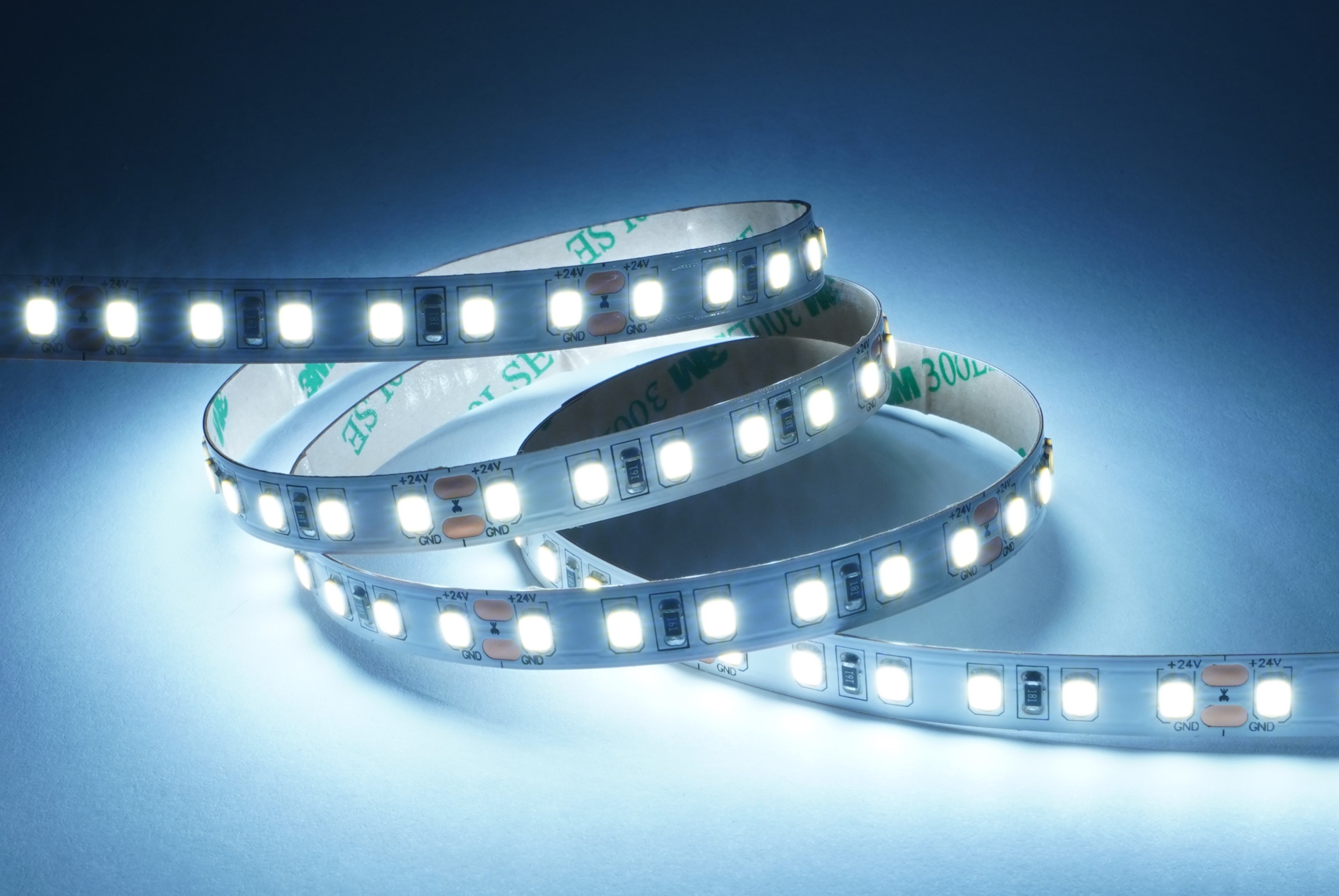

Price is per 1 linear meter – the strip is sold in multiples of one meter. Maximum single continuous section is 10m.
Door-to-door warranty as standard – check details
Download CE declaration of conformity
Download photometric files for DIALUX

5-YEAR WARRANTY on zoomLED® strips
The zoomLED® lighting brand offers professional products guaranteeing trouble-free operation for many years, confirmed by a 5-year warranty (also for commercial facilities)!
LED strip in 11000K light color
The LED strip in 11000K light color emits light with a very cool, blue-white hue. It is the coolest light color emitted by LED strips and can have various applications, such as illuminating furniture, ceilings, walls, etc. Cool light color (with a color temperature above 8000K) can be particularly useful in places where high-brightness lighting is needed, e.g., in warehouses, workshops, cold storage rooms, etc. It can also be used as effective decorative lighting, e.g., in clubs, bars, etc. However, it should be noted that cool light color can be tiring for the eyes when looked at for a long time, so it is not recommended for illuminating residential rooms or offices.
Beautiful ambient colors – high color rendering index CRI (RA)+90
Sunlight renders ambient colors perfectly, so it scores 100/100 on the CRI (RA) scale.
zoomLED® strips emit light with a CRI (RA) above 90, meaning they render real ambient colors in a way very close to natural sunlight.
Most LED strips emit light with a CRI (RA) between 60 and 80 – which unnaturally alters the colors of the surroundings.
High RA matters both for the attractive appearance of the room and for eye health, because human eyes quickly tire and dry out under artificial light with a low RA.
Uniform light color along the entire length – same BIN
Uniform light color is a concept relating to the consistency and homogeneity of the color emitted by a light source.
In the case of the zoomLED® strip, uniform light color means that all LED diodes on the strip emit light of the exact same color, without visible differences in shade or color saturation (they belong to the same BIN, meaning they are selected for the same color)
In practice, this means an LED strip with uniform light color does not produce a “spotting” or “color shift” effect when the light is perceived by the human eye.
More light from the same power
The zoomLED® brand LED strip emits more light with lower power consumption.
120 LED 10W zoomLED® strip – 106lm/1W
120 LED 10W strip from another manufacturer – ~60lm/1W
Luminous efficacy is measured in lumens per watt (lm/W), and the higher this value, the better quality lighting can be achieved with lower energy consumption. This means zoomLED® strips deliver significantly more light than others!
LED strip quality backed by photometric testing
We have our own photometric laboratory where we test every batch of LED strip, ensuring that we consistently offer the highest product quality every time.
In the laboratory, we check parameters such as:
luminous efficacy, color temperature, color rendering index, flickering, electrical potential differences, product heating, and we verify the weight of the copper traces.
24V supply voltage – plenty of benefits
A 24V-powered LED strip carries less current than a 12V strip. As a result, less power loss occurs on the strip, generating less heat, and less heat means a longer LED diode lifespan.
24V power supply also means smaller voltage drops along the strip, allowing you to create longer runs of light. An additional and very helpful advantage is that controllers used to control light on 24V LED strips require half the current capacity.
To connect the LED strip you need:
1. Power supply (an essential device for the LED strip to operate)
2. Controller (not essential, but allows you to control the light)
*Remember to exercise caution when connecting electrical devices and make sure you have the appropriate skills and knowledge to do so safely. If you have any doubts, consult a professional or an electrician.
How to choose a power supply for an LED strip?
1. check how many Watts the LED strip consumes per 1m
2. multiply the number of meters you are installing x the power of the LED strip
example: 7 meters of 19W LED strip – you need at least a 133W power supply (the power supply can be larger, but must not be smaller)
3. choose a larger power supply, definitely not smaller than you need
Still the same light after several years
The light from this strip does not dim noticeably over time, and the light color does not change its hue. Because the product is built with branded, selected LED diodes effectively regulated by precision-matched resistors, the zoomLED® strip retains its properties for many years. The LED diodes in this strip could run at a much higher luminous output than set, but thanks to the resistors limiting power on the diode, the diodes are not pushed to their maximum limits.
Good heat distribution extends lifespan
Thanks to a double-layer PCB substrate and thick copper traces running through the zoomLED® strip, the heat generated during illumination does not stay directly on the LED diode, but is distributed across the entire surface of the strip and then transferred to the surface it is adhered to, which should ideally be aluminum, as it dissipates heat excellently. The lower the operating temperature of the LED strip, the longer its lifespan. In addition to good heat dissipation, the thick copper traces also ensure uniform distribution of the supply voltage to the LED diodes along the entire length of the strip.
24V power supply offers plenty of benefits
A 24V-powered LED strip carries less current than a 12V strip. As a result, less power loss occurs on the strip, generating less heat, and less heat means a longer LED diode lifespan. 24V power supply also means smaller voltage drops along the strip, allowing you to create longer runs of light. An additional and very helpful advantage is that controllers used to control light on 24V LED strips require half the current rating!
Excellent adhesion to the surface
The zoomLED® strip is backed with branded 3M adhesive tape, guaranteeing strong and durable adhesion to the surface (the surface must be smooth and degreased).
What can an LED strip be used for?
The strip is a linear light source, meaning it creates beautiful lines of light. It can be used as the main and sole source of lighting, or as additional decorative lighting. It works ideally as illumination for suspended ceilings or edge lighting for walls. The LED strip illuminates kitchen countertops brilliantly and beautifully decorates shelves, whose backlighting adds charm to the room. The strip also serves as stair lighting that not only illuminates but also decorates. You can build lamps from LED strips or use them to illuminate retail shelves to draw customers’ attention to products. An LED strip has countless applications.
LED Strip
An LED strip is a linear light source placed on a special flexible strip with light-emitting LED diodes. Using an LED strip allows you to create linear interior lighting. This type of lighting is ideal for ceilings—the resulting effect will provide perfect ambient lighting for a cozy home. When the light reflects, it becomes softened and there are no harsh shadows. As a result, a more pleasant atmosphere prevails in the room. An LED strip also handles lighting work surfaces, such as kitchen countertops, effortlessly. Mounted in an aluminum profile installed under kitchen cabinets above the countertop with the light directed onto the surface, the strip illuminates the entire work area perfectly. In a similar way, work surfaces in workshops, studios, and workstations can be illuminated. LED strips are also used for decorative purposes. They can, for example, illuminate wall-mounted shelves. Properly selected light can significantly enhance the appearance of furniture, regardless of the room it is in. With decorative lighting, remember to ensure the LED strip is not aimed directly at the eyes – we want a nicely illuminated interior, not a glaring effect. LED strips are also successfully used in the advertising industry, illuminating advertising lightboxes and exhibition stands. When building lamps, LED strips enclosed in an aluminum profile, covered with a frosted diffuser, and suspended on cables can be used as a light source to create modern, attractive-looking luminaires.